Saturday, 6 September 2014

Findings from the Project

After this project, our group has learnt more about the Hock Lee Bus Riots that happened in 1955. We have also come to a conclusion as to why the 1950s and early 1960s should be remembered today, with reference to the Hock Lee Bus Riots.

As a quick introduction, the Hock Lee Bus Riots was one of the worst riots that happened in Singapore, leaving 4 dead and 31 injured. The blog post our group has presented shows us 4 talk points from 2 different perspectives each. We learn more about the difference between the understanding of the problem with the bus drivers themselves and their employers. 

We feel that the 1950s and 1960s are worth remembering because incidents that happened during that period of time have valuable life lessons that we, the future generation, should learn from and improve on so as to create a better future for our descendants. 

For example, the Hock Lee Bus Riots as well as the other riots that happened then teaches us that violence or riots will not solve any problem and that treating people with dignity and respect is a key factor in avoiding similar conflicts. 

It is absolutely logical for the bus drivers to pursue a better life and better working conditions, but because most of the bus drivers were illiterate at that time, they were often treated lightly and underestimated. They felt that the only way they could voice out their wants and be heard was to hold a strike. The strike they held started off as a peaceful strike without any violence but the government decided to send police troops to break off the groups, which was perfectly fine in the eyes of the law, but which at the same time, angered the protesters. Similarly, the Hock Lee Bus Company employers also decided to fire the workers indiscriminately and refused to listen or try to fulfill their employees’ requests. There is nothing illegal about the way the whole incident was handled, but the consequences of the actions that were taken out prove to us that what is legal may not always be the right thing to do. 


Hence, the 1950s and 1960s are worth remembering in order to avoid letting history repeat itself and to mould a better future for everyone, through the lessons we learnt from the Hock Lee Bus Riots.


word count: 393

Comparison of Sources

Both sources A and B, are similar in telling me that the government of Singapore during 1955 was quite chaotic. This can be seen from source A, where "I think you know, when I was first elected and appointed Chief Minister, I was told I had no office, no clerk, no thambi. And oh they couldn't give me any office - it took a long time - government offices were extremely overloaded - and there was a lot of difficulty." This shows that even political leaders' assistants were on strike and that the nation was very unruly at that time. Similarly, source B states that "From early April until the end of December 1955, Singapore witnessed a staggering 260 labour stoppages, walk-offs, go-slows and sit-downs - if we exclude Sundays, that means more than one labour protest every working day." This shows that there was no control over the strikes that were going on daily for 9 months in total. Thus, it can be seen that the government of Singapore during 1955 was quite chaotic. 

Both sources A and B, are different in content in that of when the chaotic period of government started. In source A, it states that '' Last year, this time, in the month of March: a time of agony '' ' This shows that the chaotic period in source A started in March. On the other hand, source B states that '' From early April until the end of December 1955, Singapore witnessed a staggering 260 labor stoppages, walk-offs, go slows and sit-downs. ''
This shows that the chaotic period in source B started in early April and chaotic period of government were different in both sources.

Tuesday, 26 August 2014

Journal of Meetings

1. Tuesday 26 August 2014
    Regina's House
    3.30pm - 7pm

2. Friday 8 September 2014
    Starbucks Hougang Mall
    12pm - 4pm

Members present & their roles:
Ang Jie Ling (2) - Checks that all group members understand the ideas discussed and decisions made by the group, checks the contents of the end-product, the citations, the use of sources, accuracy, spelling, grammar, etc and double-checks the quality of the end-product by checking against the rubrics provided.

Casazendra Tan (4) - Records discussion details and transfers to the blog, takes notes of the group discussions and the decisions made during the discussion. Also helps each group member keep track of progress  by recording down what is to be done by each group member and compiles the minutes of the group meetings on the blog.

Glenys Foo (7) - Keeps group members focused on the topic of the discussion or on the task, leads discussions on the distribution of work and responsibilities, ensures that every group member is in agreement, encourages all group members to participate actively in discussions, monitors that work is done by all and helps to manage any disagreements between group members.

Regina Yeo (30) - In charge of ensuring relevance of sources selected, takes charge of backup copies of all the resources and research information gathered by every group member and materials given by the teacher.


Hock Lee Bus Riots

Introduction to the Hock Lee Bus Riots credits: http://www.thesmartlocal.com/read/5-riots-that-rocked-singapore

Since early 1955, *left-wing trade unions began to organise workers, and used militant methods to obtain increased wages and improved working conditions for employees. On 24 March 1955, about 100 Hock Lee drivers and conductors took the day off when their management refused to grant them leave to attend a SBWU meeting. The company viewed the incident as a case of mass resignation by the workers and hired workers from its own employees’ union to continue bus services. On 18 and 24 April, SBWU workers in the Hock Lee Amalgamated Bus Company staged lightning strikes to protest against certain actions taken by their management. In response, the management dismissed all 229 SBWU workers in the bus company.


*Left-wing politics are political positions or activities that accept or support social equality, often in opposition to social hierarchy and social inequality.


source 1


Interview of Dr Loh Kah Seng, Institute for East Asian studies, Sogang University
Adapted from Channel News Asia documentary series Days of Rage Episode 2: Hock Lee Bus Riots

People were angry, they were not having enough to eat and to make a living. At the same
time, the British and the employers were standing together and not doing enough to meet 
workers' grievances.   


Workers listening to speech
Workers of the Hock Lee Amalgamated Bus Company going on a strike


source 2

Interview of Mr Guok Seng Swee, Former Chairman, Hock Lee Bus Company (1952-1956)
Adapted from Channel News Asia documentary series Days of Rage Episode 2: Hock Lee Bus Riots

The workers' union were very demanding, but the management was very firm. My 
company can only bring in so much money, and you are asking for more than what I bring 
in, how do I run the company? When you got too many workers, it's very difficult to control 
them. They keep asking for better terms.


b2ap3_thumbnail_hocklee.jpg
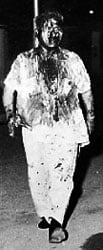
Corporal Yuen Yau Pang with his face and clothes smeared with with burning petrol, a victim of the Hock Lee Bus Riots who died later


source 3

Account of the Hock Lee Bus Riots by then 12 year old eyewitness Han Tan Yuan
Adapted from "Singapore: A Biography"

The workers participating in the strikes assembled at the gate of the Hock Lee Bus Company. The police wanted them to disperse but they refused. These were very high-pressure water cannons, strong enough to send pebbles and glass on the ground flying towards the workers. Some of the workers' bodies were cut and bleeding from the flying stones and glass. Whenever the water cannons lulled, the student sympathisers would rush to pick up pebbles and glass from the ground. They weren't trying to attack the police you only have to look at the actions of the people in the photographs and you'll see..... The water cannons were so powerful that they could blast a person into a drain. The crowd became very angry, and someone shouted in Hokkien 'hood!', which means fight.


Groups of Catholic High School and Chung Cheng High School students gathering to hold meetings and demonstrations


source 4

Comic strip depicting the story of the Hock Lee Bus Riots
credits: http://stripgenerator.com/strip/409364/history-chapter-8-hock-lee-bus-riots/view/fresh/


source 5

Interview of Mr Yoong Siew Wah, Special Branch (1951-1968)
Adapted from Channel News Asia documentary series Days of Rage Episode 2: Hock Lee Bus Riots

Chinese schools were a natural nest for communist activities. It was so widespread that it was impossible for the special branch to try to investigate the Chinese school communist activities. 


Police spraying water cannons at protesting bus drivers in an attempt to drive them away from the gates of the Hock Lee Bus Depot at Alexandra Road


source 6

Interview of Mr Wong Shiang Hoe, Student, The Chinese High School (1953-1960)
Adapted from Channel News Asia documentary series Days of Rage Episode 2: Hock Lee Bus Riots

All we felt was an aversion to the policies of the British government. When we joined the movements, we didn't even care if there are communist elements inside. The government thus suspected that we students were communists also, but were not.   


A Volunteer Special Constable, 29-year-old Corporal Andrew Teoh Bock Lan, was set upon by a mob at 8.50pm on 12 May 1955 while driving along Alexandra Road. He was beaten to death by the mob.


source 7

Interview of Mr Otto Fong, son of Fong Swee Suan
Adapted from Channel News Asia documentary series Days of Rage Episode 2: Hock Lee Bus Riots

You won't support, of couse, unless you have some personal investment in it, so all these people, all these sentiments are real sentiments whereby the downtrodden remains downtrodden and they really want to see some change, so that's why they are willing to put themselves in the line of danger. 


Hock Lee Bus Company workers holding a demonstration


source 8

Interview of Mr Han Tan Yuan, student, Catholic High School (1955)
Adapted from Channel News Asia documentary series Days of Rage Episode 2: Hock Lee Bus Riots

They were very daring and they didn't fear death. They laid on the road where the buses were supposed to exit. If you were to drive out, you'll run over these people. No one would dare to do that. 


Chinese students protesting against the police


Aftermath of the hock lee bus riots creditshttp://www.thesmartlocal.com/read/5-riots-that-rocked-singapore

By 3.00am on 13 May 1955, the rioting had subsided although island-wide strike of bus workers continued. The next day, a government arbitrator negotiated a settlement between the Hock Lee Bus Company and the SBWU in which the pre-strike rosters were restored. 4 people were killed and 31 injured. Normal bus services resumed on 16 May 1955.